TL;DR: Launch a niche crowdfunding platform in 6-10 weeks
Use Stripe payment intents with manual capture to support all-or-nothing funding that only charges backers when a campaign hits its goal.
Layer Stripe Connect on top so platform fees and creator payouts route automatically without you holding funds.
Model Campaign, RewardTier, Pledge, and Update as separate data types and cache the running total on the campaign for fast progress bars.
Display countdowns, recent backer feeds, and stretch goals to drive urgency and convert browsers into pledgers.
Build a focused MVP for one community first, then hire a specialist team when payment logic gets serious; see case studies.
What Is a Crowdfunding Platform and Who Needs One?
A crowdfunding platform lets creators raise money from a community of backers. Creators publish campaign pages with goals, timelines, and reward tiers. Backers pledge money in exchange for rewards, equity, or simply to support a cause. The platform facilitates discovery, payments, and communication between both sides.
Niche crowdfunding platforms outperform generalists in specific verticals. Real estate, independent music, local businesses, social causes, board games, and creative projects all benefit from platforms tailored to their audience. If you have access to a community that actively funds specific types of projects, that is your platform opportunity. The niche focus lets you build features and trust signals that matter to your specific audience instead of being a generic funding page.
Why Bubble Fits Crowdfunding Platforms
Crowdfunding is a multi-role web app with campaign management, payment processing, and real-time progress tracking. Bubble is a no-code app builder that handles all three. Its database supports the relational structures between campaigns, creators, backers, pledges, and rewards. Its Stripe integration handles the payment complexity including multi-party splits via Stripe Connect.
Many successful bubble app examples started as platforms that needed to launch quickly and prove market demand before investing in custom development. A crowdfunding platform is the same pattern. Build the no code MVP, attract your first campaigns, and prove that your niche has funding demand. Bubble's visual development also means you can iterate on campaign page layouts and discovery algorithms based on what actually converts backers, not what you assumed would work at launch.
Key Features to Build
1. Campaign creation. Creators build campaign pages with title, description, images, video embed, funding goal, deadline, and a rich-text story section. Use Bubble's rich text editor plugin for compelling campaign narratives with formatting, images, and embedded media. Store campaign status as an option set: draft, under review, active, funded, failed, and completed. Require admin approval before campaigns go live to maintain platform quality.
2. Reward tiers. Multiple reward levels with descriptions, prices, quantities, and estimated delivery dates. Build a RewardTier data type linked to the campaign. Backers select their tier when pledging. Track remaining quantities for limited rewards and automatically mark tiers as sold out when the limit is reached. Let creators add stretch goal rewards that unlock when funding passes certain thresholds.
3. Payment processing. Integrate Stripe for pledge payments. Decide between immediate charge or all-or-nothing where you charge only if the goal is met. For all-or-nothing, use Stripe payment intents to authorise cards at pledge time and capture charges only when the campaign deadline is reached and the goal is met. Use Stripe Connect to route funds to campaign creators minus your platform fee. Store the Stripe payment intent ID on each pledge record for reconciliation.
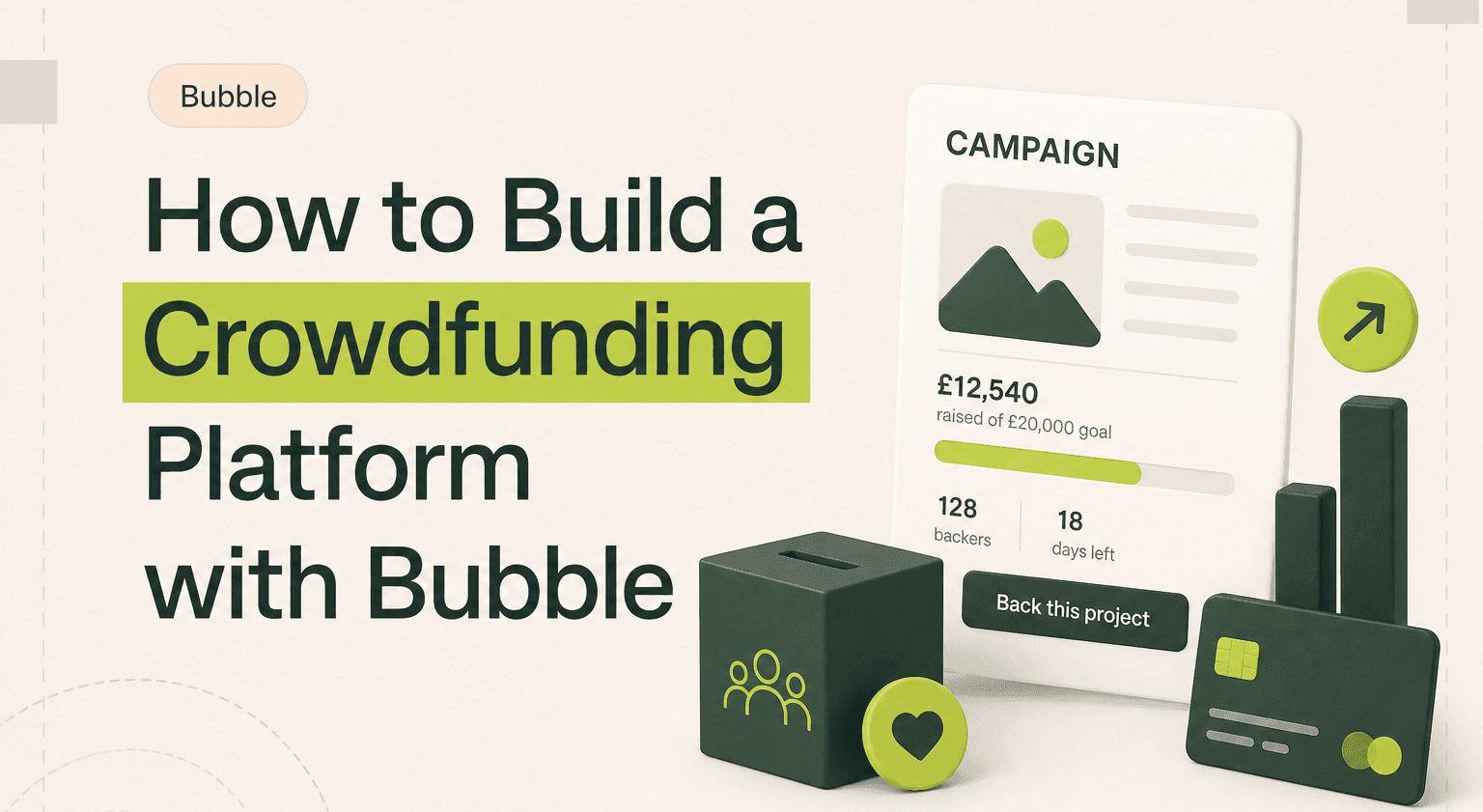
4. Funding progress display. Real-time progress bars showing amount raised versus goal, backer count, and time remaining as a countdown. These elements create urgency and social proof that drive additional pledges. Calculate the funding percentage on the campaign record and display it with a visual progress bar built using Bubble's shape element with dynamic width. Show recent backers in a live feed to create momentum.
5. Backer dashboard. Backers see their pledged campaigns, payment history, reward selections, and fulfilment status. Creators see their backer list with contact details for reward fulfilment, export capability, and can filter by reward tier. Build a fulfilment tracking system where creators update the shipping status per backer so backers can track their reward delivery.
6. Campaign updates. Creators post progress updates to their backers during and after the funding period. Each update is a separate record linked to the campaign with title, body, and images. Notify backers by email when updates are posted using backend workflows. Display updates chronologically on the campaign page so new visitors can see the creator's engagement level.
7. Discovery and search. Homepage featuring trending campaigns sorted by funding velocity, new campaigns, and nearly funded campaigns close to their goal. Category filters using option sets, search by keyword, and sorting by funding progress, deadline, or newest. Staff picks or featured campaigns for editorial curation controlled by an admin flag on the campaign record.
Architecture Overview
Data types: User (with role as option set: backer, creator, admin and Stripe Connect account ID for creators), Campaign (with creator reference, goal amount, current amount raised as cached field, deadline, status as option set, category, and content fields), RewardTier (linked to campaign with price, description, quantity limit, quantity claimed, and estimated delivery date), Pledge (linked to campaign, backer, and reward tier with amount, Stripe payment intent ID, and payment status as option set), Update (linked to campaign with title, body, images, and publish date), and Category (for campaign organization with name, slug, and display order).
The critical workflow is the pledge and payment flow. When a backer pledges, create a Pledge record, authorise their card via Stripe payment intent, and update the campaign's cached total raised amount. If using all-or-nothing funding, a scheduled workflow checks campaign deadlines daily. For campaigns that reach their goal by the deadline, capture all authorised payments and update statuses to funded. For campaigns that miss their goal, cancel the payment intents and update status to failed. Use Stripe webhooks to handle edge cases like expired payment methods. Immediate-charge campaigns are simpler: capture payment at pledge time and process refunds only on creator-initiated cancellations.
Timeline and Cost
A crowdfunding MVP takes 6-10 weeks on Bubble. Campaign pages, discovery, and basic backer accounts take three to four weeks. Payment flows add two to three weeks, with all-or-nothing funding requiring more complex Stripe integration than immediate charging. Backer dashboards and campaign updates fill the remaining time. DIY Bubble app development costs $600-$2,500 in subscriptions and Stripe setup fees. Agency builds run $20,000-$45,000 for a production-ready platform. Start with a single category or community to validate demand and prove your platform's value proposition before expanding to new verticals.
When to DIY vs Hire an Agency
DIY if you are building a simple donation or pre-order platform with immediate payment. Hire an agency if you need all-or-nothing funding logic with Stripe payment intent management, complex reward fulfilment tracking, or Stripe Connect multi-party payments with configurable platform fees. Payment handling is the one area where mistakes cost real money and destroy trust with both creators and backers. Get it right from the start because payment bugs on a crowdfunding platform are front-page problems.
Related guides:
Bubble paypal integration guide
Bubble mailchimp integration guide
Bubble sendgrid integration guide
Niche crowdfunding platforms win by understanding their community better than the generalists. Bubble gives you the speed to launch. Your community access gives you the edge. Build the platform, attract your first campaigns, and let the network effects compound as successful campaigns bring new creators and backers to your platform.
Fund Your Niche, Own Your Platform
A branded crowdfunding platform lets you serve your community without relying on Kickstarter's rules or fees. Own the audience and the revenue.
Goodspeed builds platform applications on Bubble. Talk to our Bubble developers to plan your crowdfunding build.

Harish Malhi
Founder of Goodspeed
Harish Malhi is the founder of Goodspeed, one of the top-rated Bubble agencies globally and winner of Bubble’s Agency of the Year award in 2024. He left Google to launch his first app, Diaspo, built entirely on Bubble, which gained press coverage from the BBC, ITV and more. Since then, he has helped ship over 200 products using Bubble, Framer, n8n and more - from internal tools to full-scale SaaS platforms. Harish now leads a team that helps founders and operators replace clunky workflows with fast, flexible software without writing a line of code.
Frequently Asked Questions (FAQs)
Can Bubble handle all-or-nothing crowdfunding campaigns?
Yes. Use Stripe to authorise payments at pledge time and capture them only when the campaign deadline is reached and the goal is met. If the goal is not met, release the holds. Bubble's scheduled workflows handle the deadline logic.
How much does a crowdfunding platform cost to build on Bubble?
DIY builds cost $600-$2,500 in subscriptions and plugins. Agency builds run $20,000-$45,000. The main cost driver is payment integration complexity, especially for all-or-nothing funding models.
Can I take a platform fee on each pledge in a Bubble crowdfunding app?
Yes. Use Stripe Connect to automatically deduct your platform fee from each pledge payment. The remaining amount routes to the campaign creator. You configure the fee percentage in your Bubble workflows.
How do reward tiers work in a Bubble crowdfunding platform?
Create a RewardTier data type linked to each campaign. Backers select a tier when pledging. Track available quantities and mark tiers as sold out when limits are reached. Creators manage fulfilment status per backer.
How long does it take to build a crowdfunding platform on Bubble?
A crowdfunding MVP takes 6-10 weeks on Bubble. Campaign pages and discovery are quick to build. The payment flow, especially all-or-nothing funding and multi-party payouts, adds the most development time.
Can a Bubble crowdfunding platform scale to many campaigns?
Yes. Bubble handles hundreds of concurrent campaigns and thousands of backers. Optimize search queries and use pagination for campaign listings. For very high traffic during campaign launches, consider Bubble's dedicated capacity options.