TL;DR: n8n AI Meeting Summarizer in 2026
What this unlocks: an n8n agent that pulls a transcript from Grain, Granola, Otter, or Fireflies and produces a structured recap with decisions, action items, owners, and open questions
Typical use cases: Slack-channel summaries, action items auto-created in ClickUp or Linear, attendee email digests, and topic-based segmentation for long meetings
Architecture combines a transcript source via webhook or API, an LLM for structured extraction, and routing to Slack, project tools, and email. An AI products partner handles edge cases like long calls and confidential meetings
For teams running 10+ meetings per week, this often runs alongside a wider n8n implementation covering CRM updates, task creation, and follow-up automation
This guide walks through the architecture, a concrete prompt and output, and the transcript-quality edge cases. For broader builds, see our automation services
What an n8n AI Meeting Summarizer Agent Does
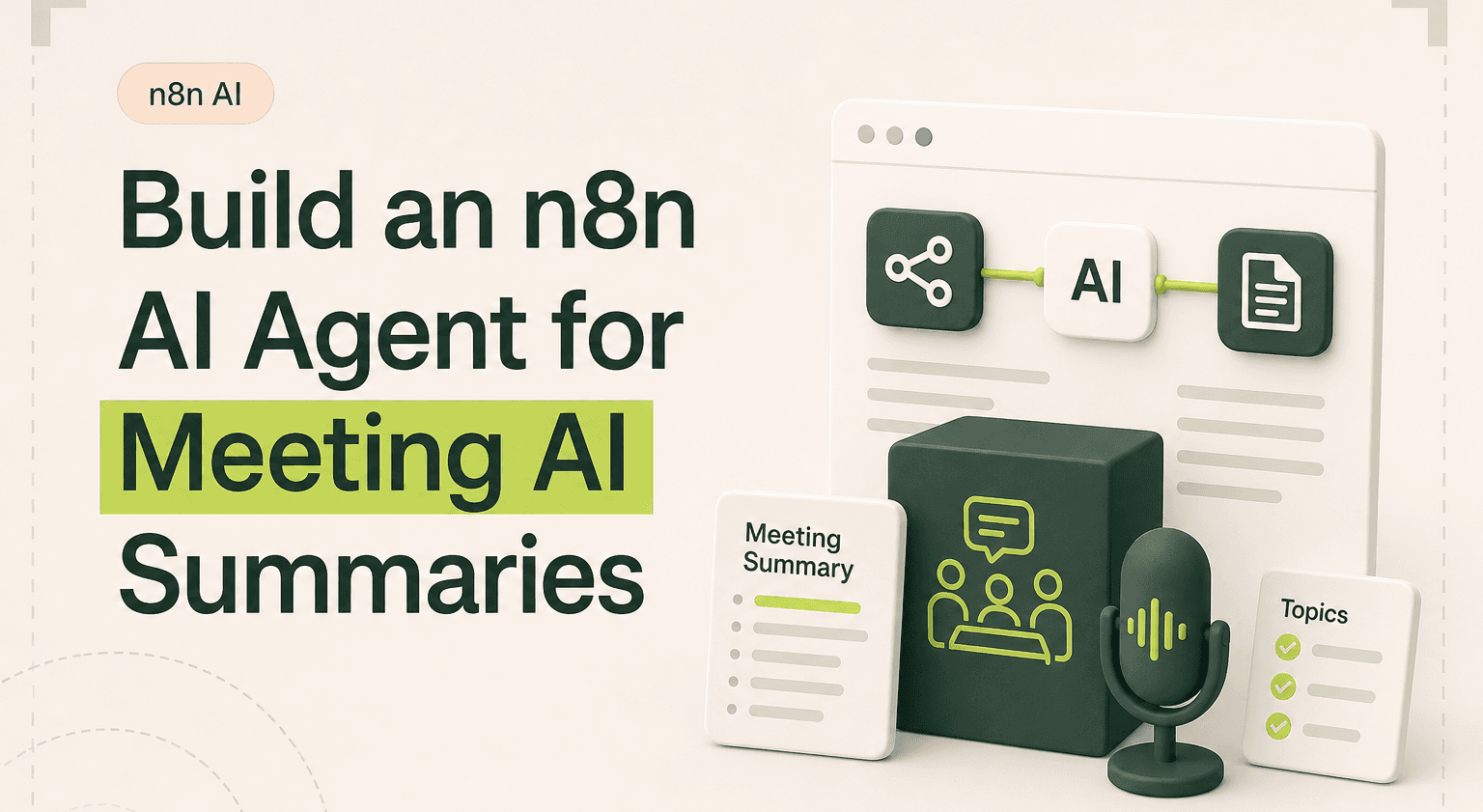
This agent takes a meeting transcript - from Grain, Granola, Otter, Fireflies, or any transcription service - and produces a structured summary. Key decisions, action items with owners, open questions, and a brief recap of what was discussed. It then posts this summary to Slack, emails it to attendees, or creates tasks in your project management tool.
The difference between this and a generic "summarise this text" prompt is structure and routing. The n8n workflow ensures the right output reaches the right people in the right format, every single time.
Architecture: LLM + Transcript Source + Delivery
The n8n workflow triggers after a meeting ends. For tools like Grain or Granola, use their API or webhook to fetch the transcript automatically. For Zoom or Google Meet recordings, process the audio through a transcription service first.
The AI agent node receives the full transcript. The system prompt defines the output format: "Summarise this meeting transcript. Output: 1) Two-sentence overview. 2) Key decisions made (bulleted). 3) Action items with owner name and deadline if mentioned. 4) Open questions or unresolved topics. 5) One-paragraph detailed recap."
The n8n workflow then routes the output. The summary goes to a Slack channel. Action items get created as tasks in ClickUp, Asana, or Linear. Attendees receive an email with the full recap. All from a single trigger.
Example Prompt and Output
A 45-minute product planning meeting finishes. The transcript is fetched from Granola automatically. The agent processes it and returns:
"Overview: The team decided to prioritize the API v2 launch for Q3 and defer the mobile redesign to Q4. Resource allocation was discussed and two new hires were approved.
Decisions: Ship API v2 by July 30. Defer mobile redesign. Approve two backend hires.
Action items: Sarah - draft API v2 spec by Friday. James - post backend engineer job listings by Monday. Priya - update the Q3 roadmap in Linear.
Open questions: Do we need a dedicated QA hire for the API launch? Revisit next meeting."
This gets posted to #product-team in Slack. Action items are created in ClickUp with the assigned owners.
Real Limitations and Edge Cases
Transcript quality varies wildly. Background noise, accents, cross-talk, and poor microphones produce transcripts with errors. The LLM handles minor transcript noise well, but heavily garbled sections lead to wrong attributions. "Sarah said" might actually have been James. Always treat AI-generated attribution as approximate.
Long meetings (2+ hours) may exceed token limits. Break transcripts into segments by topic or time blocks. Process each segment separately, then merge the summaries. The n8n workflow handles this with split and merge nodes.
Confidential meetings need careful handling. If the agent posts summaries to Slack automatically, ensure the destination channel has the right access controls. Build in a review step for sensitive meetings where a summary goes to the organiser for approval before wider distribution.
When This Works Best
This n8n AI agent is most valuable for teams running 10+ meetings per week where decisions and action items frequently get lost. Product teams, agency teams, and leadership groups benefit most. It is one of the most immediate-ROI n8n use cases because the pain of lost meeting context is universal.
When to Hire an Agency
The meeting summarizer looks straightforward but has operational complexity: connecting to multiple transcript sources, handling different meeting types with different summary formats, routing action items to the correct project tool, and managing permissions. An n8n agency builds the full pipeline including edge case handling and monitoring, so your team gets reliable summaries from day one.
Never Lose Meeting Context Again
Related guides:
n8n Gmail automation guide
An n8n AI agent for meeting summarization turns every call into a documented, actionable record. With n8n integrations for transcript tools, Slack, and project management platforms, the entire workflow runs without manual effort. The n8n automation ensures nothing falls through the cracks.
Automate Your Meeting Recaps
Meetings are only valuable if outcomes are captured and acted on. An n8n AI agent handles summarisation and delivery so nothing gets lost. Goodspeed builds meeting automation workflows that connect your transcript tools to Slack, email, and project management.

Harish Malhi
Founder of Goodspeed
Harish Malhi is the founder of Goodspeed, one of the top-rated Bubble agencies globally and winner of Bubble’s Agency of the Year award in 2024. He left Google to launch his first app, Diaspo, built entirely on Bubble, which gained press coverage from the BBC, ITV and more. Since then, he has helped ship over 200 products using Bubble, Framer, n8n and more - from internal tools to full-scale SaaS platforms. Harish now leads a team that helps founders and operators replace clunky workflows with fast, flexible software without writing a line of code.
Frequently Asked Questions (FAQs)
What transcript tools integrate with n8n for meeting summaries?
n8n works with Grain, Granola, Otter.ai, Fireflies, and any tool with an API. Zoom and Google Meet recordings can be processed through a transcription service first. The HTTP Request node connects to any transcript source with a REST API.
Can the agent distinguish between different speakers in the transcript?
If the transcript includes speaker labels (most tools provide this), the agent uses them to attribute statements and action items to specific people. Without speaker labels, the agent summarises content without attribution.
How does the agent handle very long meetings?
For meetings exceeding the LLM token limit, the n8n workflow splits the transcript into time-based or topic-based segments. Each segment is summarised separately, then a final agent call merges the segment summaries into one cohesive recap.
Can the agent automatically create tasks from action items?
Yes. The agent extracts action items with owners and deadlines. The n8n workflow then creates tasks in ClickUp, Asana, Linear, or Jira using their native nodes. Task assignment works if the owner names match your project tool’s user list.
How quickly does the summary appear after the meeting ends?
Typically 1-3 minutes after the transcript becomes available. The bottleneck is usually the transcription tool’s processing time, not the n8n workflow. LLM summarisation of a one-hour meeting takes about 15-30 seconds.
Can I customize the summary format for different meeting types?
Yes. Use conditional logic in the n8n workflow to detect meeting type (from the calendar event title or a tag) and apply different system prompts. A standup gets a brief format. A client call gets a detailed recap with follow-up items. A planning meeting gets decisions and action items.