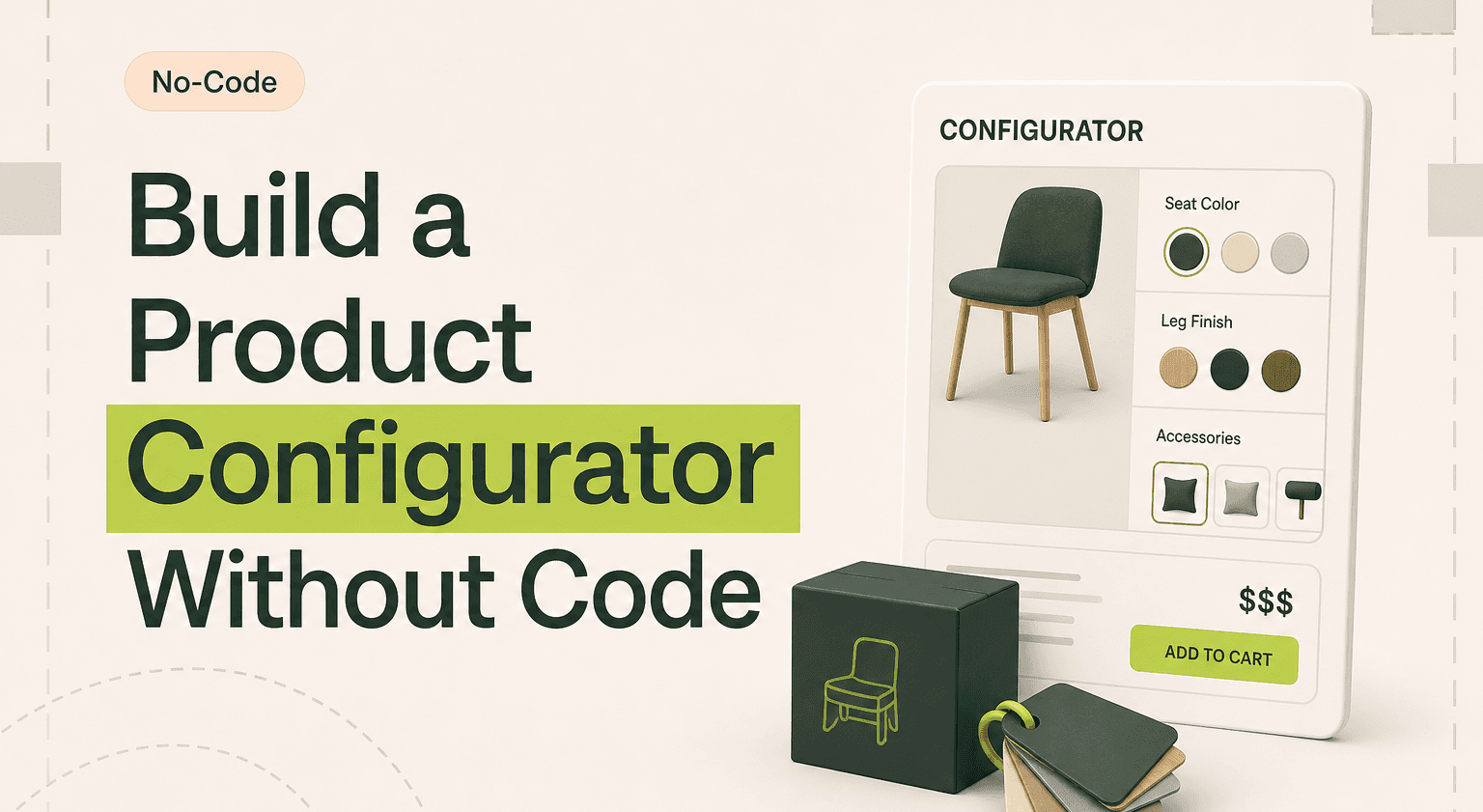
A product configurator has four building blocks: multi-step flow, option dependencies, dynamic pricing, and quote generation. On Bubble, you can build an MVP in a week and a production version in 8-12 weeks. You need clear pricing rules, product specs in one place, and CRM integration. No developers required.
The four building blocks
Every product configurator, regardless of complexity, needs four elements: a rules engine that knows your pricing logic, a user interface where customers make selections, a calculation layer that applies those rules in real time, and an output - usually a quote or order confirmation. That's the architecture of every product configuration tool we've ever built. A simple five-product configurator has a simple rules engine. A complex one with hundreds of combinations has more sophisticated logic. But the building blocks remain constant.
The rules engine is where configurator development actually happens. This is where you define what happens when someone selects certain options: does it enable other features, does it change price, does it restrict certain combinations? The interface is where users interact with those rules - buttons, dropdowns, toggles, visual selectors. The calculation layer processes selections and applies your pricing. The output is what the customer gets: a visual quote, a PDF, data sent to your order system. Each block matters, but none of them requires writing code anymore.
What you need before you start
Before you build a product configurator, document your pricing logic clearly. List every product option, every combination, every price modifier. If you can't explain your pricing in a spreadsheet, you can't build a no-code configurator around it. This isn't a technical constraint - it's a clarity constraint.
You also need to understand who's using it. Is this for your sales team, your customers, or both? That changes the design. A sales team configurator can be information-dense because they understand your products. A customer-facing Bubble configurator needs to be obvious - colours, sizes, options presented in a way that makes sense to someone seeing your product for the first time. Visual configurator builder tools make this distinction matter less; you can design for different user types easily. But you need to decide before you start building.
The build timeline week by week
Weeks 1-2: Discovery and rules mapping. We understand your products, your pricing, your customer segments, and what success looks like. Weeks 3-4: Design and prototyping. We show you what the configurator will look like, where options live, how customers navigate. You give feedback, we iterate. Weeks 5-8: Build the core functionality. Rules engine, pricing calculations, basic interface. This is where no-code CPQ platforms shine - we're not writing thousands of lines of code; we're configuring a pre-built system.
Weeks 9-10: Testing and refinement. We find edge cases - weird combinations that break pricing, user flows that confuse people - and fix them. Weeks 11-12: Deployment and training. Your system goes live, your team learns how to use it, your customers start configuring. No-code configurator tools compress what used to take six months into twelve weeks. That's what we've learned building 200+ products and specializing in speed.
Why no-code works for physical products
Physical products have constraints that digital products don't, especially made-to-order products: material costs, manufacturing times, shipping weights, inventory limitations. No-code platforms aren't less capable of handling these - they're actually better suited. You can define business rules without touching code. If a customer selects a certain material, it automatically increases lead time and cost. If they select incompatible options, the system prevents the combination. If certain colours are only available for certain sizes, that logic exists in your configurator, not in your sales team's head.
Build product configurator logic for physical products isn't novel. It's often simpler than digital product configurators because the relationships are more straightforward. Material affects cost, size affects weight, finish options have stock constraints. These aren't fuzzy business rules - they're concrete facts. A Bubble configurator lets you encode these facts into a system that applies them consistently every time. That consistency is where errors disappear and your sales team actually trusts the tool.
From MVP to production
Your first version doesn't need to handle every edge case. Start with your top-ten products or your most common configuration patterns. Get something live quickly, understand how customers actually use it, then expand. Configurator development following the MVP approach moves faster than trying to build the perfect system before launch. By week twelve, you have something functional. By week sixteen, you have something that handles 80% of your business. Perfect is the enemy of useful.
Scaling a no-code configurator is straightforward once the foundation exists. Adding more products means replicating logic patterns you've already built. Adding pricing complexity means extending rules you understand. We've gone from launching configurators with ten products to running the same system with 300+ options because the architecture supports growth. That's why no-code matters: you're not rewriting the foundation every time you add features. You're just adding to a system that's already proven. Related reading: step-by-step migration from spreadsheets, real configurator pricing breakdown, CPQ for small business, how configurators fix the sales bottleneck, why Shopify can't handle complex products.
Start Building Next Month
You don't need developers. You don't need 18 months. Audit your quoting process, define your product matrix, map your pricing rules, and find a no-code builder who's done this before. Your customers will drive improvements.
Six months from now, you'll have a tool that's cut your sales cycle in half. DM me if you want to talk through what this looks like for your product.

Harish Malhi
Founder of Goodspeed
Harish Malhi is the founder of Goodspeed, one of the top-rated Bubble agencies globally and winner of Bubble’s Agency of the Year award in 2024. He left Google to launch his first app, Diaspo, built entirely on Bubble, which gained press coverage from the BBC, ITV and more. Since then, he has helped ship over 200 products using Bubble, Framer, n8n and more - from internal tools to full-scale SaaS platforms. Harish now leads a team that helps founders and operators replace clunky workflows with fast, flexible software without writing a line of code.
Frequently Asked Questions (FAQs)
What are the core building blocks of a configurator?
Four pieces: (1) Multi-step flow - walk customers through a sequence instead of one massive form. (2) Option dependencies - if they pick material A, certain finishes become unavailable. (3) Dynamic pricing - price changes in real-time based on selections. (4) Quote generation - PDF output with configuration, price, specs, and a unique quote ID saved to your CRM. That's it. Every configurator we've built uses these four pieces.
How long does each piece take to build on no-code?
On Bubble: multi-step flow with conditional logic takes one day. Dependencies using conditionals take a day. Dynamic pricing formulas take a day. Quote generation with a PDF plugin takes a day. You've got a working MVP in a week. Then you iterate, test with customers, add edge cases, and polish. Total production build: 8-12 weeks.
What do I need to know before I start building?
Three things: (1) Your pricing model has to be clear - if a customer picks option A, what's the cost? Spend a week defining this, our <a href="/blog/spreadsheet-to-configurator">spreadsheet-to-configurator migration guide</a> walks through the process. (2) Your product specs need to be in one place, not scattered across emails and your founder's brain. (3) Your CRM integration is non-negotiable - quotes must flow into HubSpot or Salesforce, attached to the contact record.
What does the build timeline actually look like?
Weeks 1-2: Define pricing and product specs. Weeks 3-4: Design user flow and wireframes. Weeks 5-9: Build on no-code platform. Weeks 9-10: Test with your team, fix issues. Weeks 11-12: Beta with customers, final tweaks, launch. This isn't fast and loose. It's fast and rigorous.
Why is no-code perfect for physical product businesses?
<a href="/blog/cpq-small-business">CPQ for SaaS</a> is complicated - usage tiers, seat counts, annual vs monthly pricing. CPQ for physical products is cleaner. You have materials, sizes, finishes, configurations, and a price. The logic is linear. That's why no-code works perfectly here. You're not solving a complex pricing problem. You're automating a logical workflow.
Where can I learn more about the technical details?
We've written a deeper technical guide on building configurators with Bubble: goodspeed.studio/blog/create-a-no-code-product-configurator-with-bubble. The thing most founders miss is you don't need permission to start. You don't need a three-month scoping session. You can start building next month.