Training a $1bn HR company to become AI builders and save $105k a year

  • Industry

    HR

  • Tools

    • n8n

  • Services

    • Development

    • Design

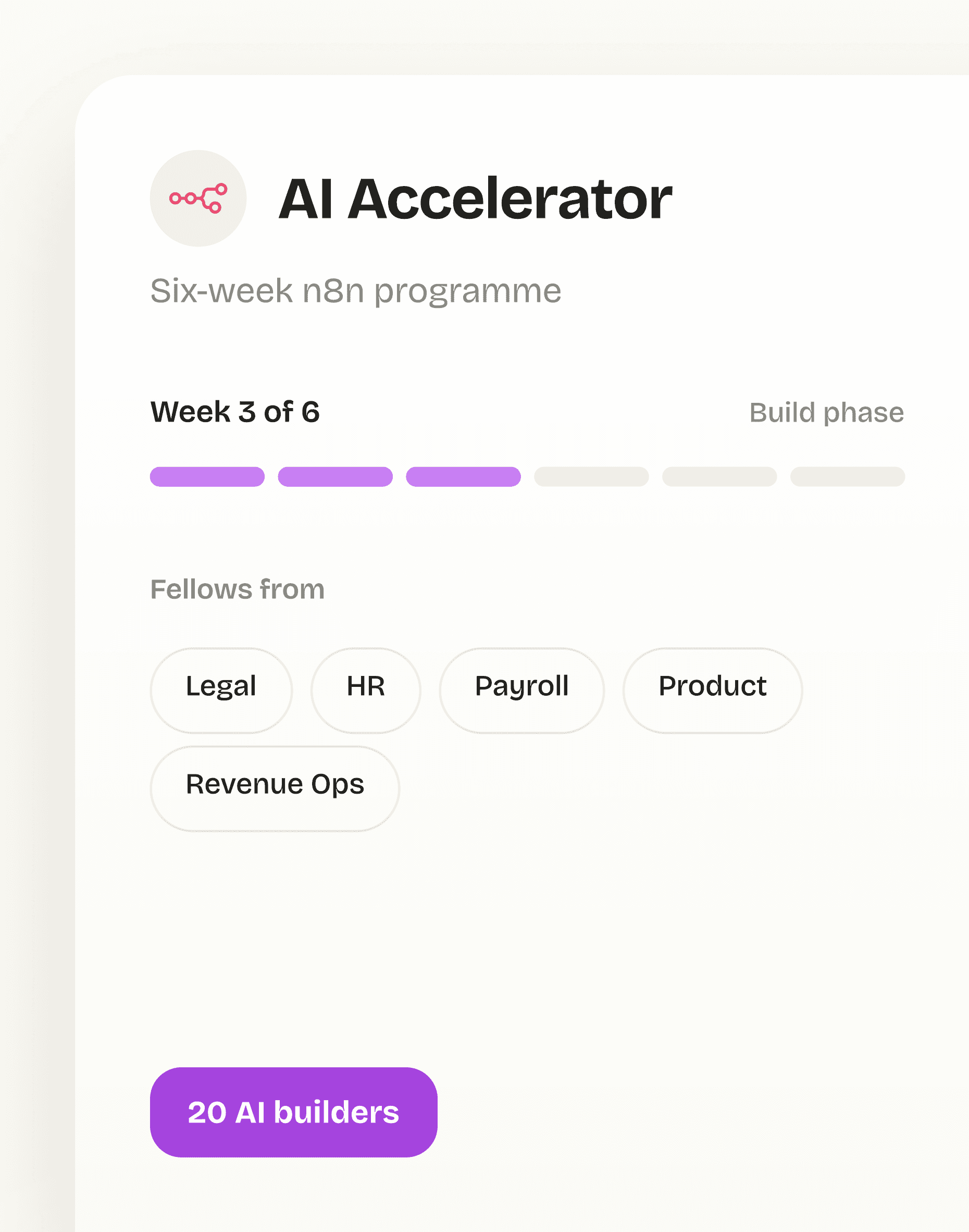
Oyster is a $1.2bn global employment platform, an Employer of Record that helps companies hire, pay and support teams across 180+ countries, and they wanted that capability to live inside their own people. So we ran the AI Accelerator, a six-week n8n programme that took ~20 people from Legal, HR, Payroll, Product and Revenue Operations, most starting from zero, and turned them into builders who now ship and maintain their own workflows. Oyster's own measurement: $105k a year and 3,658 hours given back to teams with all their live automations.

This is for operations, HR or finance leaders who want their own people to build and own automations, not a build they cannot change themselves. If that is you, book a call.

  • $105k

    Projected annual impact

    Projected annual impact

  • 3,658

    Hours saved per year

    Hours saved per year

  • 20

    Employees turned into AI builders

    Employees turned into AI builders

  • Oyster runs on process. Contracts, payslips, onboarding checks, tax forms, treasury exceptions and HR queries are the machinery of a global employment platform, and every one of them is a stack of repeatable manual steps carried out by specialists. The usual fix is to hire an agency to build the automations for you, but that creates a dependency: every future change, every new edge case, routes back through the vendor. Oyster wanted the capability to live inside their own teams. So instead of asking us to build, they asked us to teach.

  • Hadi Moussa, CEO, Oyster

    You looked at what we actually do, found the bottlenecks, and built solutions. For me, that's what owning outcomes looks like. You proved it works.

    Hadi Moussa

    CEO, Oyster
  • person using MacBook Pro
    a close up of a keyboard with a blue button
    MacBook Pro on table beside white iMac and Magic Mouse
    MacBook Pro on table beside white iMac and Magic Mouse
    robot and human hands reaching toward ai text
    person writing on white paper
  • person using MacBook Pro
    a close up of a keyboard with a blue button
    MacBook Pro on table beside white iMac and Magic Mouse
    robot and human hands reaching toward ai text
    person writing on white paper

Next Case Study

Moving a Finance SaaS Off Wix and Onto Framer in 6 Weeks

Highpath is a funding workspace for founders, CFOs and financing partners. We migrated their site off Wix Studio, rebuilt it as a 20-page site in Framer, and turned one flat website into three role-based buyer journeys, with tracking carried across and no downtime.

  • Framer

Finance

Highpath on a laptop

A 6B-view creator network, off Webflow and onto a site its team runs

Bent Pixels runs a YouTube creator network with more than 6 billion monthly views. Its Webflow site had stopped keeping up, and the plan to fix it was a day of AI prompts.

Instead, we moved it from Webflow to Framer in six weeks, gave the team a site they run themselves, and then extended into decks, call backgrounds and social assets.

  • Framer

Media

Bent Pixels on a studio display

How we helped an NVIDIA-backed AI unicorn ship new pages as fast as it shipped models

Goodspeed was Reka AI's (reka.ai) embedded design and development team. We designed and built reka.ai in Framer, and shipped every launch page, solution page and campaign asset.

Reka, an NVIDIA-backed AI unicorn, shipped frontier models constantly, and every model launch needed a landing page, solution pages and assets ready the day it went out. We were their entire design and dev team, working off a single visual system flexible enough to ship for any audience fast. New product pages went live the day of announcement, and the engagement was extended.

  • Framer

AI

Frequently Asked Questions

    • Can you actually train non-technical staff to build automations, or do we need engineers?

      Oyster's employees came from Legal, HR, Payroll and Revenue Operations, most starting from zero. Six weeks later they had shipped live automations they built and now maintain themselves. The constraint was never technical background, it was giving people a real problem and a mentor beside them.

    • Isn't it faster to just have you build the automations for us?

      Faster to launch, slower forever after. Build-for-you creates a dependency where every change routes back through us. The Accelerator puts the capability inside your teams, so they fix, extend and add workflows without waiting on anyone. Oyster ended with builders in every department, not a backlog of tickets.

    • How do you measure the impact of a programme like this?

      Oyster measured it themselves: $105k a year in projected impact and 3,658 hours given back to teams once all Accelerator automations are live, with workflows already running in production. Hours saved is the part that is easy to count. Fewer errors and better customer experience moved too.

    • What if the automations touch sensitive data, like payroll or contracts?

      A payroll employee built a matching engine that hit 85% accuracy without sending any employee data to an AI model, compliant by design. A lawyer migrated the entire executed-contract archive into a single controlled source of truth. Automation and data governance are not in tension when the workflow is designed properly.

    • How long does it take and how much of our team's time does it need?

      Six weeks: two weeks of n8n fundamentals, then four weeks of mentored building on a real problem from each person's own job. Employees did it alongside their day jobs. One built hers while she was still being onboarded to the company.

Goodspeed logo icon

Join our newsletter

© 2026 Copyright. All Rights Reserved.