Bubble has supported native iOS and Android builds since mid-2025, alongside PWAs and wrappers. The agency matters more than the platform, so hire one with live mobile apps and app store experience. We compare five agencies on mobile track record, speed and price, and show two Bubble mobile apps we have shipped.
TL;DR: Best Bubble Agencies for Mobile App Development in 2026
Bubble now supports native mobile app development (launched 2025) alongside PWAs and responsive web apps, making it a serious option for mobile products.
The top agencies for Bubble mobile are Goodspeed (us: native iOS, Android and PWA builds on Bubble), AirDev (Canvas framework, enterprise), Rapid Dev (fast MVPs, ChurchSpace), Idea Link (data-heavy field tools), and Zeroqode (large Bubble plugin and template library).
Key comparison criteria: native vs PWA experience, app store publishing support, push notifications, mobile performance optimization, and post-launch support.
We put Goodspeed first because we have shipped a native iOS and Android app (BunkerEx, built in two weeks) and a festival-scale PWA (Ambit) on Bubble. We are on this list ourselves, so ask every agency for live mobile work, ours included.
Why Bubble for Mobile App Development?
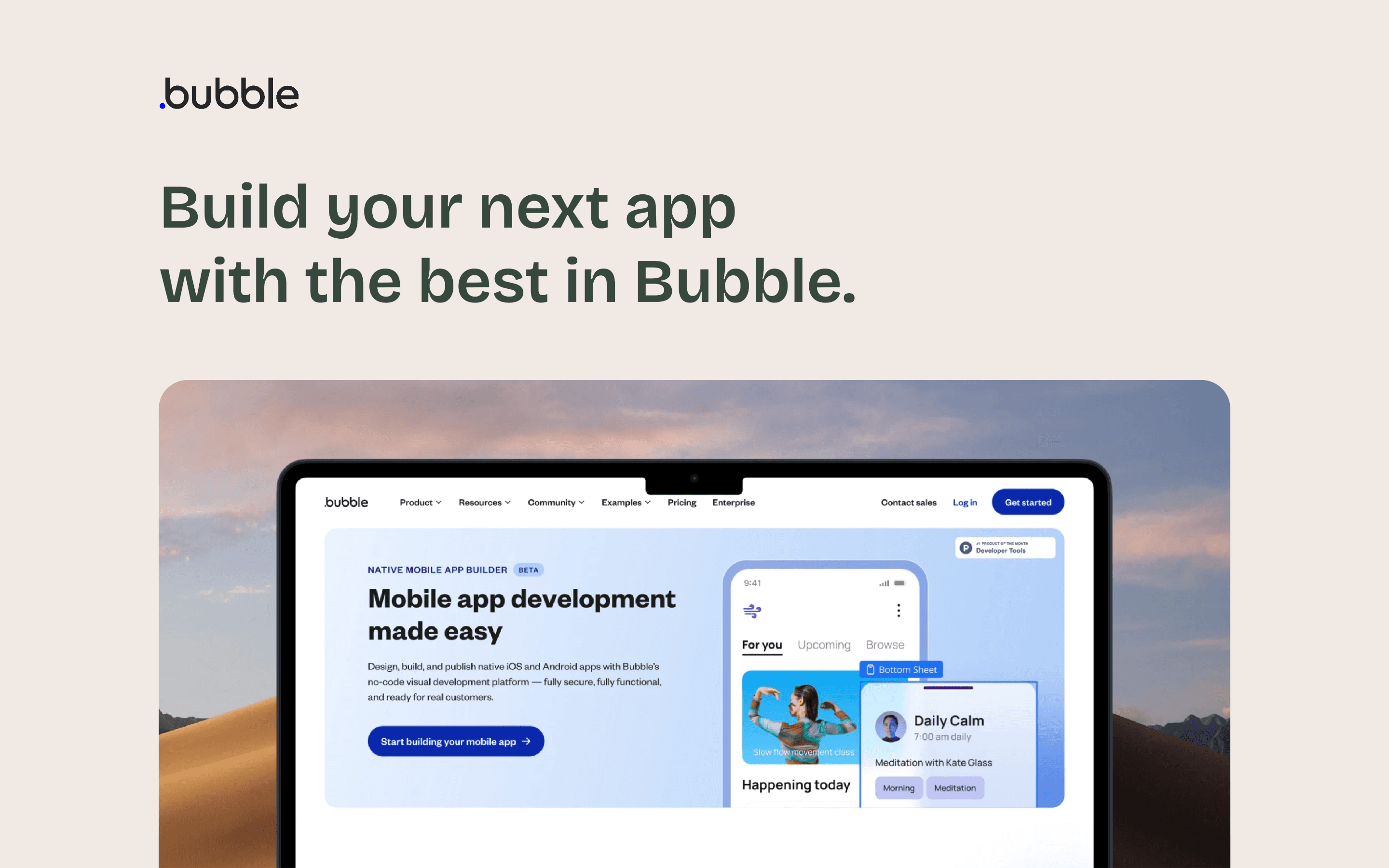
Bubble stands out as a leading platform for no-code mobile app development. Traditionally focused on responsive web applications and progressive web apps (PWAs), Bubble now also supports native mobile development through its 2025 native mobile builder. Apps can be designed, tested, and deployed directly to iOS and Android without relying solely on third-party wrappers.
Combined with established tools like BDK Native, Cordova, or Natively.io, teams can add native capabilities: push notifications, offline access, camera and GPS integration, biometric login, and home-screen installation.
For entrepreneurs, startups, and internal teams, this means you can prototype, iterate, and launch mobile apps quickly without deep coding expertise. Bubble's visual editor, integrated backend, scalable infrastructure, and real-time workflow logic handle user authentication, role-based access, API connections, and mobile-optimized performance, all while reducing cost and time-to-market compared to traditional development.
Bubble Native Mobile: What Changed in 2025
The biggest update to Bubble's mobile story happened in mid-2025: native mobile app building went into public beta.
Before this, Bubble developers had three options for mobile: responsive web apps, progressive web apps (PWAs), or wrapping Bubble apps with third-party tools like BDK Native, Natively.io, or Cordova.
The native mobile builder changes the equation. You can now build iOS and Android apps directly inside Bubble without relying on wrappers. The app compiles natively, which means access to push notifications, biometric login, camera, GPS, and app store distribution without the performance compromises that come with web-based wrappers.
What the Native Builder Supports
Native push notifications built into Bubble's workflow engine.
Direct submission to the App Store and Google Play.
Access to device features (camera, GPS, biometrics) without plugins or JavaScript bridges.
Native navigation patterns (tab bars, stack navigation) that feel like a traditional mobile app.
What It Does Not Replace
PWAs remain a strong option for apps that do not need app store distribution. Responsive web apps are still the right choice for mobile-friendly tools that live in the browser. And for teams that need deep customization or platform-specific behavior, third-party wrappers like BDK Native still offer the most flexibility.
What This Means for Choosing an Agency
When evaluating Bubble agencies for mobile work, ask whether they have experience with Bubble's native mobile builder specifically, not just responsive web design or wrapper-based deployments.
The build process, testing workflow, and app store submission process are different from traditional Bubble development. Agencies without native mobile experience may underestimate the learning curve.
Not sure whether to go native, PWA, or responsive? Goodspeed has shipped mobile products across all three approaches. Book a free consultation and we will recommend the right path for your product.
Book a free consulting call with Goodspeed
How Bubble Compares to Alternatives
Traditional development with Swift or Kotlin requires hiring developers, maintaining codebases, and longer cycles of 3 to 9 months depending on complexity.
Costs range from $30,000 on the low end to $250,000+ for richer apps. Bubble can compress MVP timelines to weeks in many cases, though teams still need to configure mobile responsiveness in Bubble's responsive engine.
Glide is well-suited for simple data-driven apps built from spreadsheets, but it is limited in custom workflows, backend logic, and scalability for complex mobile apps. It lacks built-in API workflows or custom logic support. See the full Glide vs Bubble breakdown.
Webflow is ideal for visually responsive static websites with some interactivity, but it lacks Bubble's integrated database, logic workflows, and user authentication systems required for dynamic mobile applications like marketplaces or social networks. Here is how Webflow vs Bubble compares in detail.
Adalo offers native mobile app development with a visual builder and built-in components, but has limitations in performance, third-party API integrations, and backend flexibility compared to Bubble's extensibility through plugins and custom APIs. See Adalo vs Bubble for a side-by-side comparison.
Bubble bridges the gap by offering web-first development that can be adapted for mobile deployment. This makes it more versatile for hybrid use cases than mobile-specific tools like Adalo or data-centric tools like Glide. For a full platform overview, read our Bubble.io Review.
Key Features of Bubble for Mobile App Development
Responsive Design, PWA, and Native Build Options
Bubble's responsive engine makes it easy to adapt layouts across mobile, tablet, and desktop screens. Apps can be configured as progressive web apps (PWAs), allowing users to install them on their home screens for a near-native feel.
Since June 2025, Bubble's native mobile builder (public beta) also enables direct iOS and Android builds, reducing reliance on third-party wrappers like BDK Native or Cordova. This gives teams flexibility to ship mobile-ready apps as responsive web apps, PWAs, or true native apps from a single Bubble project.
Built-in Database and Workflows
Bubble's visual database and workflow engine let you manage user data, authentication, permissions, and conditional logic without code. For mobile, Bubble now includes native push notification actions in its mobile stack. For PWAs or wrapper-based builds, teams often integrate OneSignal or similar tools.
API Integrations and Plugins
Bubble's Plugin Marketplace and API Connector allow integration with external services such as Stripe, Google Maps, Twilio, and others. This is more versatile than Glide's reliance on spreadsheet-based logic or Adalo's more limited third-party configurations.
Scalability and Version Control
Apps built on Bubble can scale from MVP to production-grade with its cloud hosting. Bubble supports version control through development/live versions and offers feature branching for enterprise plans, allowing teams to preview and test updates without affecting the live app.
Custom Logic and States
Bubble allows management of complex app logic using custom states and workflows. This visual logic system helps in creating multi-step forms, interactive elements, and dynamic user experiences across desktop and mobile views.
Our Evaluation Framework
Proven Expertise in Bubble for Mobile-Responsive Builds. We prioritized agencies with extensive experience in using Bubble to create mobile-optimized web apps that function well on iOS and Android devices via responsive design.
Portfolio of Successful Mobile App Projects. Agencies were ranked based on their demonstrated history of delivering responsive Bubble-based web apps with mobile app-like features, including offline access, browser-based notifications, and integration with native device functions through wrappers or external tools.
Client Feedback on Mobile Development Outcomes. We analyzed reviews and case studies from clients who developed mobile-friendly web applications using Bubble, emphasizing satisfaction with speed-to-market, usability on smartphones, and post-launch support.
Integration Capabilities with Mobile Tools. Top agencies excel in connecting Bubble apps to mobile-accessible APIs such as geolocation, camera access through HTML5, and third-party platforms like Firebase for real-time data syncing.
Scalability and Performance for Mobile Users. Rankings considered agencies' ability to build scalable Bubble web apps optimized for mobile access, including fast load times and minimal client-side processing.
Cost-Effectiveness for Mobile App Startups. We evaluated pricing models suitable for entrepreneurs developing MVPs or lightweight mobile-friendly apps on Bubble, assessing cost structures that balance affordability with quality.
How to Compare Bubble Agencies for Mobile: What to Ask
Not every Bubble agency has mobile-specific experience. Here is what to evaluate before hiring:
Native vs PWA track record. Ask for specific examples of mobile apps they have built. A responsive web app that looks okay on a phone is not the same as a native mobile product submitted to the App Store.
App store submission experience. Getting a Bubble-built app approved on the App Store or Google Play has specific requirements around performance, navigation patterns, and compliance. Agencies with wrapper or native builder experience understand these requirements. Those without it will learn on your project.
Push notification implementation. Push notifications are critical for mobile engagement but require specific setup in Bubble (either through the native builder or a tool like OneSignal). Ask how the agency handles push notifications and whether they have done it before.
Mobile performance optimization. Mobile users are less forgiving of slow load times than desktop users. Ask about Workload Unit optimization, lazy loading strategies, and how the agency tests mobile performance specifically.
Post-launch mobile support. Mobile apps require ongoing updates for OS compatibility, app store policy changes, and user feedback. Ask whether the agency offers structured post-launch support or if handoff means goodbye.
Goodspeed has shipped mobile apps on Bubble using native builds, PWAs, and wrappers. We know which approach fits which product. Talk to us about your mobile app.
Book a free consulting call with Goodspeed
Top 5 Bubble Agencies for Mobile App Development
1. Goodspeed
At Goodspeed, we build Bubble apps for mobile as native iOS and Android builds, PWAs or store-wrapped apps, depending on how your users will install and use the product. We were named Bubble Agency of the Year (2024-2025). Recent mobile work includes BunkerEx, a native iOS and Android app for a shipping-industry tech company that we built in two weeks, and Ambit, a PWA launched for a 250,000-person street festival.
We take a scale-first approach: apps are built to handle growth from day one. That covers responsive design, offline-adjacent workflows, user roles, and usage volumes, without costly rebuilds.
Our team brings deep platform expertise and a structured sprint model focused on clean database design, modular workflows, and fast mobile performance under load.
From push notifications and Stripe billing to integrations with OpenAI, Zapier, Segment, and Make, we build mobile products that feel native on phones. Post-launch, we support teams with async sprints for feature rollouts, UX refinements, and wrapper or native-builder deployments.
2. AirDev
AirDev is one of the most experienced Bubble agencies, with over 1,000 projects delivered since 2015 across SaaS platforms, marketplaces, and mobile-friendly PWAs. They are best known for their proprietary Canvas framework, which speeds up delivery while covering key mobile app needs like secure auth, multi-role access, responsive layouts, and structured data handling.
Case studies include Teach For America, where AirDev replaced spreadsheets with a custom mobile-accessible CRM in just 4 weeks. As a certified Bubble Gold Partner, AirDev is a reliable choice for teams that need enterprise-grade mobile apps with predictable delivery, strong data privacy, and scalable architecture.
3. Rapid Dev
RapidDev is a fast-moving Bubble agency specializing in mobile-first PWAs and apps for SMBs and scale-ups. They have built products like ChurchSpace, described as the first native mobile app built with Bubble, featuring bookings, payments, and venue management. It was later showcased on Bubble's official site as a mobile success story.
Known for shipping quickly without sacrificing quality, Rapid Dev focuses on clean database structures, maintainable workflows, and integrations with tools like Zapier and Airtable. With over 80 verified Clutch reviews, they are a strong choice for teams that want a working mobile app in weeks, with room to iterate and scale over time.
4. Idea Link
Idea Link is a seasoned European Bubble agency known for data-heavy mobile apps and hybrid stacks (Bubble + Xano/APIs). They have delivered over 30 products, including Open Infra, an all-in-one ERP with GPS used by field teams for mobile scheduling, asset tracking, and multi-role approvals.
Their 20+ person in-house team, with developers who have coding backgrounds, brings advanced technical skill. They often extend Bubble's limits with custom plugins and backend optimizations to keep mobile apps fast under heavy usage. As a Bubble Silver Partner, Idea Link is a reliable pick for companies needing robust, mobile-ready internal platforms or field tools.
5. Zeroqode
Zeroqode combines deep Bubble expertise with an extensive plugin and template library. Their Air Native service, which converted Bubble apps into iOS and Android builds for App Store and Play Store publication, has been discontinued and no longer takes new licenses.
Before it closed, they supported multiple apps through this process, with real examples of published apps. Their plugin and template library still speeds up Bubble development, so if you need store presence, ask how they handle native deployment today.
Side-by-Side Agency Comparison
Agency | Speed | Price Range | Ideal For |
|---|---|---|---|
Goodspeed | 2 to 10 weeks on recent mobile builds | From $10K | Founders/ops teams wanting a polished mobile PWA/native fast, with a clean path to scale |
AirDev | 4-8 weeks | From $10K | Organizations needing enterprise-grade mobile PWAs |
Rapid Dev | 4-6 weeks | From $5K | SMBs/scale-ups needing a working mobile app quickly with maintainable handover |
Idea Link | 3-8 weeks | From $5K | Data-heavy, field-ops mobile apps and hybrid stacks |
Zeroqode | 3-5 weeks | From $5K | Teams building on a Bubble core with ready-made plugins and templates |
Bubble Mobile Apps We Have Shipped
BunkerEx, a tech partner to the shipping industry, had clients with no easy way to check order progress, and the team was losing more than 10 hours a week sending updates by hand. We tested low-fidelity wireframes with real users, refined the UX in Figma, then built a native iOS and Android app in Bubble in two weeks. It syncs with BunkerEx's private database through Zapier and Bubble's API Connector, pushes real-time order status to clients automatically, and lets clients filter and download their own CSVs. The team now saves more than 10 hours a week.
Ambit, a St. Paul community app, had ten weeks to get ready for Grand Old Day, a street festival of around 250,000 people. The cleanest way to reach that crowd was a progressive web app installed from QR codes on posters across the city, with an interactive map, a bookmarkable lineup, push notifications tied to set times and one-tap directions for vendors. It went live on June 1st, attendees signed up during the event, and Ambit has grown 30% month on month.
The lesson from both: choose native or PWA based on how your users will find and install the app, not on which sounds more impressive.
If you are deciding between native, PWA or a wrapper for your own product, our Bubble development team can scope the build and recommend the route that fits your users and launch date.
Related: Most Successful Bubble App Examples
Cost and Timeline Benchmarks
Bubble is primarily a no-code web app platform whose apps can be made responsive and configured as progressive web apps (PWAs). For app store distribution and native features, teams have traditionally used wrappers such as BDK Native or Cordova. Since June 2025, Bubble also offers a native mobile builder (public beta), enabling direct iOS/Android builds without relying on third-party wrappers.
Costs and timelines vary by scope. Beyond Bubble's base plan fees, expect incremental costs for plugins or services. Many are free, but paid add-ons typically range from $10 to $30+/month per plugin (e.g., OneSignal push notifications start at $19/month). Development rates for experienced Bubble teams typically fall around $25 to $150+/hour.
Timelines are driven by iteration cycles, cross-device testing, integrations, and database/security complexity. Many MVPs built on Bubble ship in 4 to 12 weeks, while larger builds with custom workflows, advanced data handling, and native mobile packaging can take several months.
Tier | Typical Cost Range | Typical Timeline | Key Characteristics |
|---|---|---|---|
DIY / Freelancer | $2K - $25K | 4-8 weeks | Low-cost, fast MVPs. Limited QA and scalability. Relies on one builder's expertise. |
Boutique No-Code Agency | $15K - $60K | 4-12 weeks | Structured sprints, UX design, scalable data setup, PWA or native builds. |
Enterprise / Full-Stack | $100K - $400K+ | 3-9 months | Complex apps with multiple integrations, custom backends, security reviews, large teams. |
Implementation Checklist
1. Scope the Project. Define the app's purpose, target users, core features, and success metrics. Deliverable: a project scope document outlining MVP features.
2. Plan the Data Structure. Identify required data types, user roles, and database needs in Bubble. Deliverable: a data model diagram with Bubble's data types and privacy rules.
3. Design the User Interface. Create responsive pages and elements using Bubble's visual editor for mobile compatibility. Deliverable: wireframes and styled pages in Bubble.
4. Set Up User Authentication. Implement sign-up, login, and role-based access controls including email and social logins (Google, Facebook). Deliverable: functional user authentication workflows.
5. Build Core Workflows. Develop logic for key actions like app submissions, content management, or task tracking using Bubble's workflow editor. Deliverable: tested workflows for main features.
6. Integrate External Services. Connect APIs or tools (Stripe for payments, Google Analytics, Mailchimp for email automation) via Bubble's plugin system or API connector. Deliverable: configured plugins and API connections.
7. Test Thoroughly. Conduct unit, user, and performance testing across devices and browsers. Deliverable: bug list and resolution report.
8. Optimize for Performance. Review and refine loading times, responsiveness, and scalability using Bubble's built-in tools. Deliverable: performance audit and optimizations.
9. Prepare for Launch. Set up a custom domain via DNS configuration, optimize SEO settings in Bubble, and configure app store publication using wrappers like BDK Native or the native builder. Deliverable: launch plan and promotional assets.
10. Launch and Monitor. Deploy the app to live, monitor usage using Bubble's built-in analytics or integrated tools (Google Analytics, Mixpanel), and gather feedback for future updates. Deliverable: monitoring dashboard and initial update roadmap.
Build Your Mobile App on Bubble. Goodspeed Will Get You There.
Bubble in 2026 is a credible platform for mobile apps. Between the native mobile builder, PWAs and wrappers, there is a route to mobile for most products.
What separates agencies is mobile-specific experience: apps shipped through the App Store and Google Play, push notifications that work, performance on real phones, and the judgement to tell you whether native, PWA or a wrapper fits your product.
That is the work we do. We built BunkerEx a native iOS and Android app in two weeks, and gave Ambit a PWA that was ready for a 250,000-person festival in ten weeks.
If you have a mobile app to build, talk to our Bubble development team and we will scope the right route for your users and launch date.

Harish Malhi
Founder of Goodspeed
Harish Malhi is the founder of Goodspeed, one of the top-rated Bubble agencies globally and winner of Bubble’s Agency of the Year award in 2024. He left Google to launch his first app, Diaspo, built entirely on Bubble, which gained press coverage from the BBC, ITV and more. Since then, he has helped ship over 300 products using Bubble, Framer, n8n and more - from internal tools to full-scale SaaS platforms. Harish now leads a team that helps founders and operators replace clunky workflows with fast, flexible software without writing a line of code.
Frequently Asked Questions (FAQs)
Can Bubble build native mobile apps?
Yes. Bubble launched a native mobile builder in mid-2025. You can build iOS and Android apps directly in Bubble with push notifications, device features like camera and GPS, and submission to the App Store and Google Play.
What is the best Bubble agency for mobile apps?
It depends on what you are building. Look for an agency with live native or PWA apps and app store experience. We built <a href="/casestudy/bunker-ex">BunkerEx</a> a native iOS and Android app on Bubble in two weeks. AirDev suits enterprise PWAs, Zeroqode on its plugin and template library, and Idea Link on data-heavy field tools.
How long does it take to build a mobile app on Bubble?
MVPs typically ship in 4 to 12 weeks. Timeline depends on complexity, integrations, and whether you choose native, PWA, or wrapper deployment. More complex apps with custom workflows take 3 to 4 months.
Does Bubble support app store publishing?
Yes. Through the native mobile builder or third-party wrappers like BDK Native, Bubble apps can be submitted to both the Apple App Store and Google Play Store.
Should I build a PWA or native app with Bubble?
PWAs work well for apps that do not need app store distribution or deep device access. Native builds are better for products requiring push notifications, biometrics, camera access, or a presence in the App Store and Google Play.
How much does a Bubble mobile app cost?
It depends on scope. A simple build from a freelancer can cost a few thousand dollars, while agency builds with native packaging and several integrations usually run into the tens of thousands. Add Bubble plan fees and any paid plugins, such as a push notification service. Get a fixed scope before comparing quotes.
Can a Bubble mobile app handle thousands of users?
Yes. With proper database optimization, efficient workflows, and the right Bubble plan, Bubble mobile apps can scale to thousands of concurrent users. Enterprise plans offer dedicated server instances.
What should I ask a Bubble agency before hiring for mobile?
Ask for specific mobile case studies, their experience with Bubble's native builder or wrappers, app store submission track record, push notification implementation experience, and post-launch support structure.